
News
Jan . 28, 2026 13:56 Back to list
High load-bearing rigging loops ensure the safety of lifting operations
The rigging ring is the core protective connector of the steel wire rope, also known as the chicken heart ring or triangular ring
The core is used at the end loop of the steel wire rope, which disperses bending stress by fitting the curvature of the steel wire rope, prevents the rope loop from being squeezed, deformed, and worn at the pin/shackle, greatly extends the service life of the steel wire rope, improves the safety and stability of lifting, traction, bundling and other operations, and is widely used in all steel wire rope operation scenarios such as port loading and unloading, engineering machinery, ship shipping, construction, power installation, logistics traction, etc.
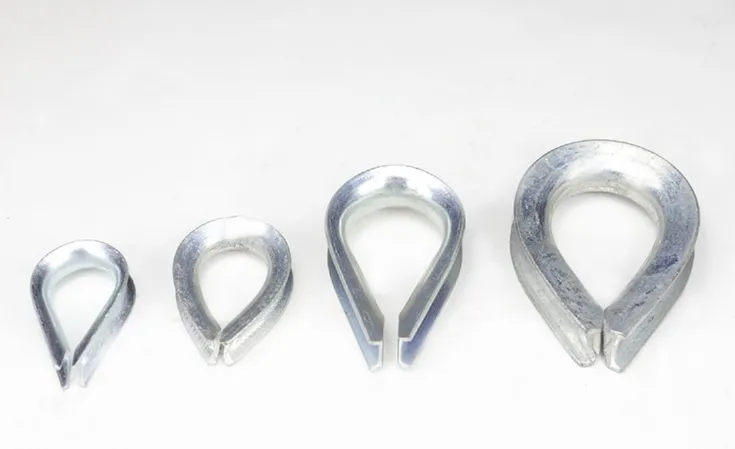
Classified by appearance and function
-Straight loop: Conventional universal version, with a standard arc-shaped inner groove, suitable for over 90% of steel wire rope loop connections, and the most widely used.
-Edge/curved loop: The edge is equipped with raised protective edges to prevent the steel wire rope from slipping off the side of the loop when under force, suitable for scenarios such as large shaking amplitude, high-altitude operations, and inclined traction.
-Customized loop: special styles such as long and short legs, large openings, and with sleeves, suitable for customized needs of non-standard steel wire ropes, irregular connection points, and special lifting angles.
Principle of specification calibration
The core calibration specification is based on the nominal diameter of the steel wire rope, with common specifications ranging from 6mm, 8mm, 10mm, 12mm, 16mm, 20mm to 100mm. It is necessary to strictly follow the principle of "matching the specifications of the ring with the diameter of the steel wire rope one by one", and it is prohibited to use coarse ropes for small rings (which are prone to breakage due to stress concentration) or fine ropes for large rings (which are prone to slipping and falling off of the steel wire rope).
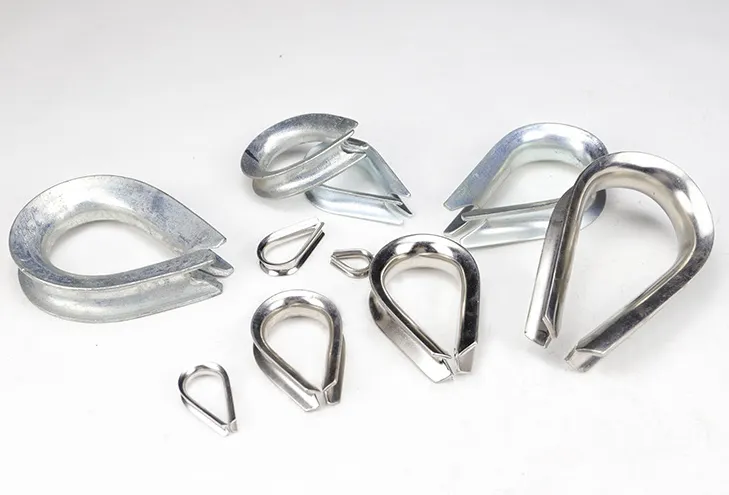
The production and manufacturing of high-quality collars always adhere to the core principle of "safety".
The mainstream collars are mostly made of high-strength alloy steel, carbon steel, and other materials, refined through multiple processes such as forging, stamping, and heat treatment. Some collars under special working conditions may also undergo anti-corrosion treatments such as galvanizing and spraying, making them suitable for harsh working environments such as ocean, humidity, and high temperature.The inner wall is smooth polished without edges or burrs, effectively avoiding wear and cutting of rigging (steel wire ropes, steel cables, etc.) due to stress concentration at bends, greatly extending the service life of rigging, and evenly distributing tension to ensure the stability of connection parts, reducing operational risks from the source.
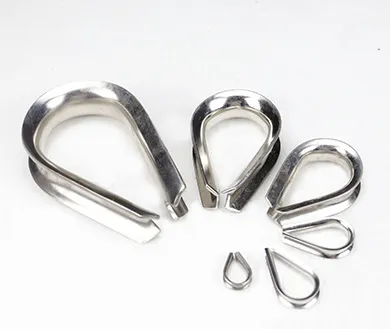
From precision operations in industrial production to practical scenarios in daily applications, the small yet refined nature of the ring embodies the industrial concept of "details determine safety". It does not have a complex structure, but with its excellent quality and precise adaptation, it has become an indispensable "connecting link" in the rigging system.
This is the last article
-
High load-bearing rigging loops ensure the safety of lifting operations
NewsJan.28,2026
-
Small components of lifting ring nuts with large load-bearing capacity
NewsNov.24,2025
-
Flower basket bolts inject stable strength into your project
NewsNov.18,2025
-
Although the lifting ring is small, its function is enormous
NewsNov.12,2025
-
Lifting shackle: The indispensable "safety connecting ring" in lifting operations
NewsNov.05,2025
-
Full analysis of lifting chain technology and application standards
NewsOct.31,2025
